Skip to content

Until December 2023, many industry experts were optimistic in predicting that by the third quarter of 2024, the bicycle industry would return to pre-2021 sales and supply levels, resembling the period between 2014 and 2019. However, the reality is far more complex than expected.


Currently, the market exhibits an unusual level of complexity: retail sales fluctuate frequently, and many consumers remain hesitant to make purchases.
The market faces dual challenges of supply-demand mismatch, with some models in short supply while others face sluggish sales. Additionally, the ongoing wave of layoffs in the industry shows no clear signs of slowing down, casting a shadow over the industry’s future prospects.
On a macroeconomic level, increased stock market volatility, concerns about economic recession, and weak consumer confidence create long-term pressure. However, on the other hand, some consumers have started returning to physical stores, showing support through their actions.
According to data from PeopleForBikes and the U.S. Sports & Fitness Industry Association, the enthusiasm for cycling remains high, with the number of cyclists maintaining pandemic levels. Thus, while the situation is not entirely pessimistic, it is indeed a mix of both positive and negative factors.

Inventory levels remain high
The bicycle industry currently faces two core issues: first, there is a severe backlog of supplier inventory, accompanied by a shortage of specific models for retailers; second, retail inventory levels remain high, yet there aren’t enough consumers to absorb it.
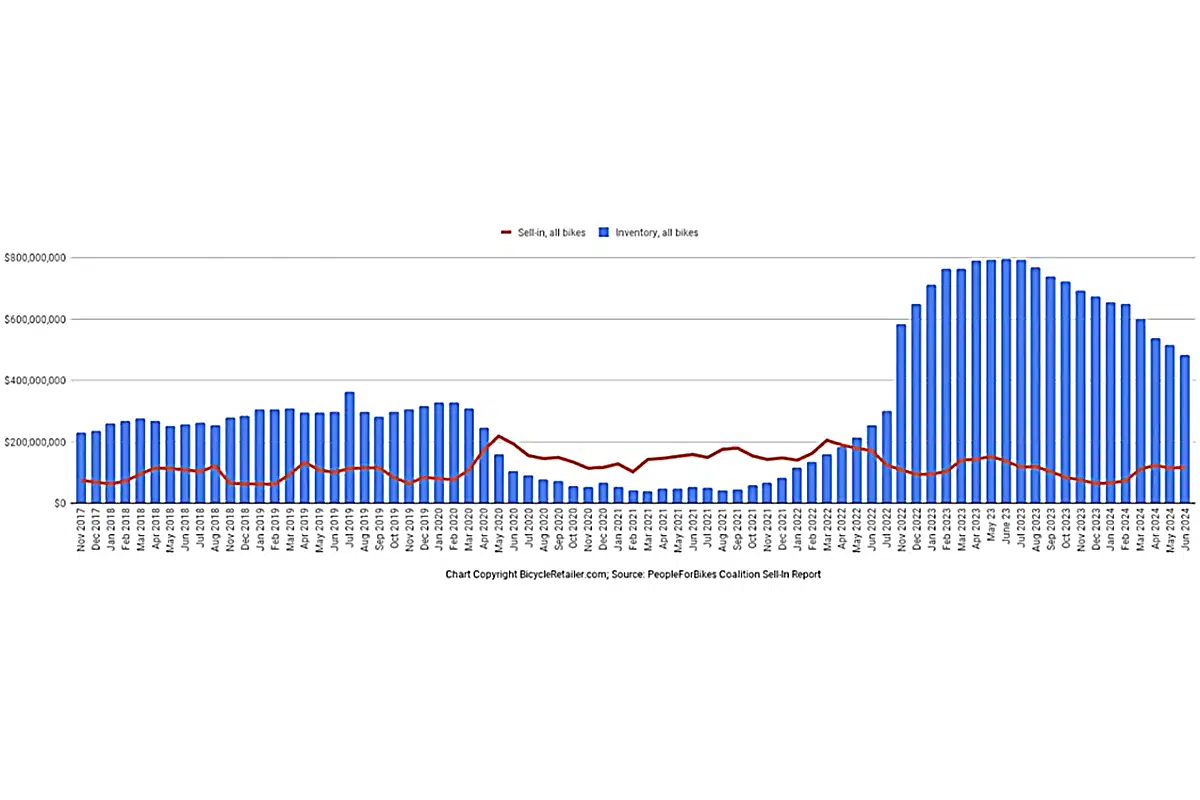
A chart created by BRAIN based on PeopleForBikes data clearly illustrates the evolution of supplier inventory and retailer sales from November 2017 to June of this year. Explore the top 10 electric bike wholesale manufacturers for your reference.
Historical data shows that inventory levels remained stable between 2018 and 2019, plummeted during the pandemic, and then surged from late 2022, reaching historic highs by the summer of 2023. While there has been some decline since then, inventory levels remain elevated.
Looking at the dealer side, sales remained relatively stable outside of the pandemic period, but the inventory-to-sales ratio has become significantly imbalanced, rising from 2.9:1 in 2018 to 4.1:1 by June 2024, highlighting the substantial inventory pressure.
Liam Donoghue, Senior Research Manager at PeopleForBikes, pointed out that May 2024 sales (in dollar terms) were 8% higher than the average of the four years before the pandemic but 35% lower than the four years after the pandemic, close to the levels of 2019 and at least the first three quarters of 2020.
He further analyzed that while the total inventory is similar to pre-pandemic levels, the inventory value has soared by 74%-131% due to price increases, and the rate of decline has not met expectations.
The sales side faces similar challenges, with total sales close to pre-pandemic levels, but bicycle sales have dropped significantly by 29%-36%. This reflects that while dealers can maintain overall sales by raising unit prices, the drop in sales volume directly impacts profits.
The battle between brands and dealers
Faced with thin profit margins, dealers are cautious about increasing inventory to avoid exacerbating capital risk. The high inventory costs for suppliers have prompted retailers to adopt a conservative approach, even with deferred payment or discount offers, and they are reluctant to increase inventory.
Instead, they prefer to streamline inventory and shift the risk upstream in the supply chain, a stark contrast to the pre-pandemic Bike 3.0 model, where suppliers assumed all inventory risk.
Some dealers are even considering abandoning direct-to-consumer sales or Click & Collect channels to avoid the risk of inventory build-up, instead relying on after-sales service revenue to offset direct sales losses. Brands, in turn, are retaining internal inventory of popular models to ensure the operation of D2C and C&C channels, further exacerbating the supply-demand imbalance in the market.
Is the transfer of inventory risk a temporary phenomenon or the new normal in the Bike 4.0 era? Only time will tell. However, as the inventory crisis gradually eases and consumer confidence recovers, bike shops may regain popularity, dealers’ ability to bear inventory risk may improve, and brands’ pre-sale capabilities may also rebound. In the short term, though, the market will need patience to adjust and adapt.
The example of the Spanish market
Amidst the ongoing global fluctuations in the bicycle market, the Spanish bicycle industry has shown unique resilience and vitality. According to the latest data released by the Spanish Ministry of Industry and Tourism, the first half of 2024 saw Spain produce 171,200 bicycles.
Although this figure represents a 6.4% decline compared to the same period last year, a deeper analysis reveals that this slight drop masks more positive industry dynamics. Who are the top 10 electric bike manufacturers in Spain?
A slight decline in production is actually a high-level adjustment
Notably, in the second quarter of 2024, Spanish bicycle production steadily rebounded to around 30,000 units per month, indicating that the industry is rapidly adapting to market changes and achieving effective capacity adjustments.
The Spanish Bicycle Industry Association (AMBE) pointed out that this year’s slight production decline is actually a natural adjustment from the exceptionally high output in 2023.
Last year, Spain’s bicycle exports significantly exceeded imports, resulting in an annual trade surplus of €78 million, up significantly from €56 million in 2022, further solidifying its competitiveness in the international market.
Post-pandemic industry recovery
Particularly noteworthy is the fact that in recent years, the Spanish bicycle industry has achieved rapid development, successfully withstanding the impact of the COVID-19 pandemic and showing strong growth momentum in the post-pandemic era.
In 2023, Spain’s annual bicycle production exceeded 300,000 units, far surpassing the pre-pandemic level of 225,000 units in 2019, making it a force to be reckoned with in the EU’s bicycle production sector.
Even in the first half of 2024, amidst global supply chain uncertainties and subtle changes in market demand, Spain managed to maintain stable production output, showcasing its industry’s deep foundation and flexible adaptability. You can also check the top 10 electric bike manufacturers in Europe for your reference.

Positive signals emerge, future prospects look bright
As 2024 progresses, the Spanish bicycle industry continues to emit positive signals. Although production slightly dipped in June, overall production in the first half of the year showed a steady upward trend, especially reaching a monthly production peak of 32,100 units in May, indicating that the industry is gradually overcoming seasonal fluctuations and entering a stable growth track.
In terms of production value, the first six months of 2024 achieved €140 million in value, with the second quarter slightly increasing from €68.8 million in the first quarter to €71.5 million, reflecting the continued warming of market demand and effective utilization of capacity.
Furthermore, the average price of bicycles produced in Spain has stabilized at over €819, roughly the same as last year. This not only reflects the steady improvement in product quality but also suggests that the Spanish bicycle industry is gradually moving towards high-end and branded development.


 English
  German
  Italian
  Dutch
Dutch  Danish
  French
  Spanish
  Finnish