Skip to content


Sensor according to the EPAC (Electric Power Assisted Cycle) standard, the e-bike must be started by pedaling, and if the pedaling stops, the bike must also stop.
Manufacturers are required to place a speed sensor on the pedal shaft and may also add a sensor that measures the force (torque) placed on the pedals by the rider.
Although most electric bike users can change the speed of their ride on their own, more often than not, the bike relies on the pedaling rhythm and force felt by the sensor, which in turn controls the bike’s speed.
One of the parts of e-bike – sensors can be divided into cadence sensors and torque sensors.
As the name implies, the torque sensor senses how hard the rider is pedaling to obtain a high precision torque value to understand the rider’s riding intentions.
The cadence sensor is mounted on the crankset and consists of induction contacts and a magnetic steel ring, which determines the need for boost by measuring the pedaling frequency; the greater the pedaling frequency, the stronger the boost.

As with any system that needs to work together, good e-bike performance starts with the accuracy of the parts of e-bike.
The sensor is equivalent to the human sensory system, and the clearer the feeling, the better the human judgment.
The torque sensor is more complex and precise than the other sensors.
By measuring torque, the torque sensor provides more accurate input values for the controller to work with.
The parts of e-bike of a high-quality e-bike usually has more than one sensor, but uses a combination of pedaling frequency and torque to determine the current riding status.
For example, some e-bike motors are equipped with high-precision torque sensors and cadence sensors, which can accurately transmit information about the rider based on pedaling frequency and pedaling force, helping the sensors to judge and output power.
The sensor will accurately transmit the input signal to the controller.
And the other parts of e-bike – controller receives the torque, speed, pedaling frequency signal, through the operation of the output signal, controls the motor running speed, start, stop and other functions, to guide the motor on how to force it.
The controller is like a human brain, which can connect all electronic parts of e-bike together, such as the battery, motor, throttle, display and various sensors, and is responsible for tracking the e-bike’s pedal activity, battery voltage, motor power, acceleration and deceleration, and other important functions.
In addition, the controller also provides some simple protection functions, such as high-voltage and low-voltage protection for the battery to prevent it from being overcharged or overdischarged, as well as the ability to monitor the temperature and current of the motor to keep the rider riding safely through braking protection.
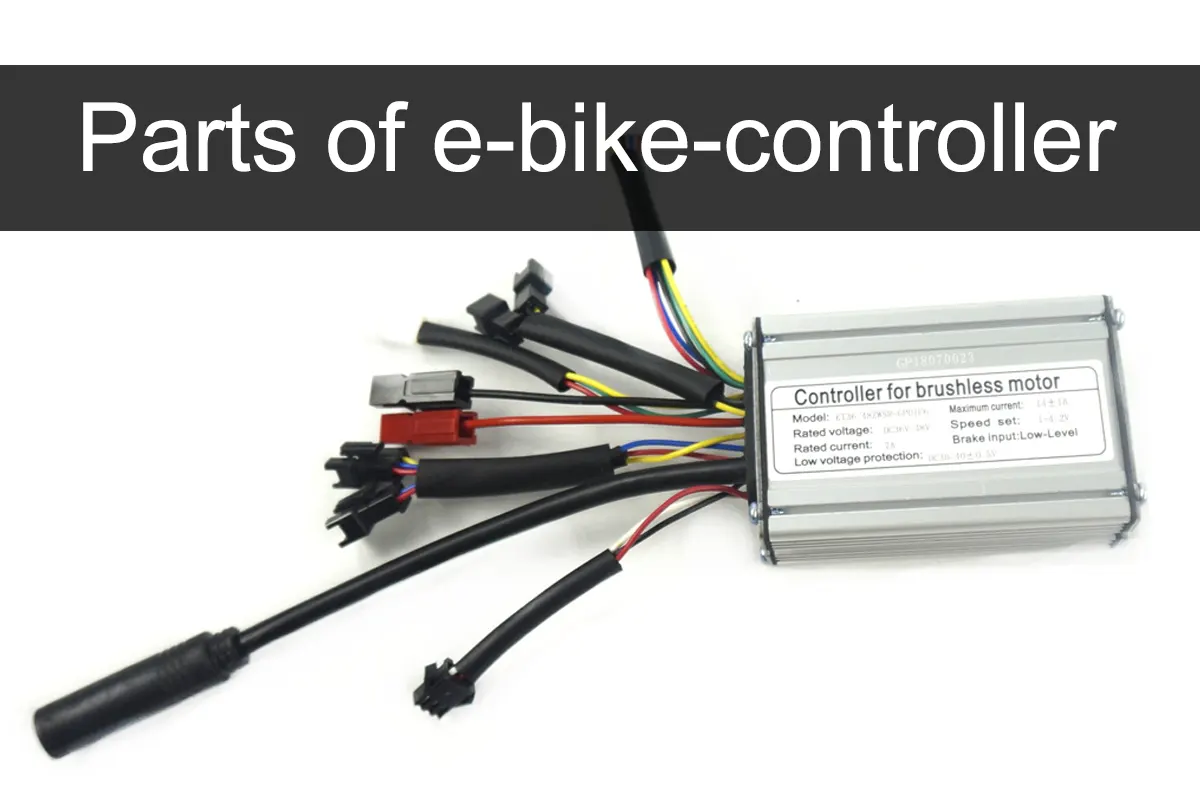
The controller also has the difference between sine wave and square wave, both of which have their own advantages and disadvantages.
Many mountain e-bike riders will choose to replace the controller in order to pursue speed, but the controller wiring lines are complex, but also need expertise as an aid. It’s best for green land not to try hard.
The controller algorithm is what we call the control program, but also our technical department is called the “invisible hand of God.”
For example, some e-bike brands have Eco (most economical mode), Tour (comfort mode), Sport (Sport mode), Sport+ (Sport Plus mode), Boost (most powerful mode), Boost mode, the choice of power gear determines the amount of power when riding, and all of these depend on the role of the program.

Best electric bike manufacturer SAMEBIKE focuses on quality sports, e-bike manufacturing, sales and service.
We advocate an active and healthy lifestyle, take the promotion and development of cycling culture as the root, and aim to create an international first-line e-bike brand.


 English
  German
  Italian
  Dutch
Dutch  Danish
  French
  Spanish
  Finnish